The Town That Got Left Behind Built Something Nobody Expected
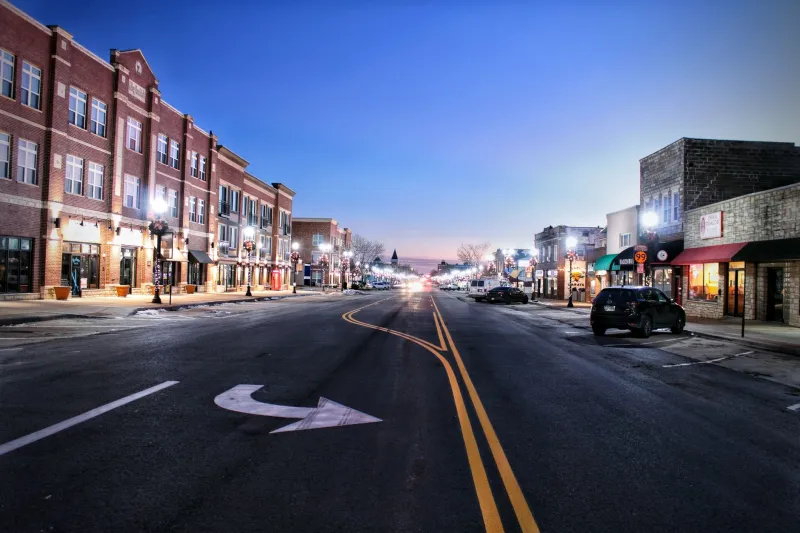
The road into Paintsville, Kentucky takes you past shuttered storefronts and rusted infrastructure that tells a familiar Appalachian story. The coal industry that built this town is a ghost of itself. The young people who were supposed to be the future left, most of them, for Louisville or Columbus or wherever the jobs were supposed to be.
The story you expect to find here is one of decline. Of a community in the long, slow process of being erased.
That's not the story.
What Getting Left Behind Actually Looks Like From the Inside
Johnson County — the county that contains Paintsville — has an unemployment rate that regularly runs above the national average. Median household income sits well below the Kentucky state average, which itself sits below the national one. Broadband infrastructure arrived late and remains inconsistent. The nearest major airport is two and a half hours away.
By every conventional metric, this is a place that the American economy left behind.
But metrics have a way of missing what's actually happening on the ground. And what's been happening on the ground in and around Paintsville over the past decade is something that urban innovation consultants, with their coworking spaces and venture capital pipelines and "innovation district" master plans, have largely failed to manufacture in cities that supposedly had every advantage.
People here started building things. Not because an accelerator invited them to. Not because a tech giant opened a satellite office. Because there was no other option, and because the skills for building things were already here — embedded in a culture that had always had to make do, improvise, and solve problems with whatever was at hand.
The Maker Tradition That Was Always There
Appalachian culture has a long, underappreciated relationship with fabrication. The region's history is dense with people who built their own tools, repaired their own equipment, and engineered solutions to problems without access to professional support networks. That tradition didn't disappear when the coal economy collapsed. It just went looking for new applications.
Randy Combs grew up watching his father rebuild mining equipment in a garage workshop. When the mines started closing, Combs didn't see a skills deficit — he saw a skills surplus with nowhere to go. In 2016, he converted a former hardware store on Paintsville's main drag into a community fabrication workshop: CNC routers, laser cutters, 3D printers, welding equipment. He called it the Hollow Makerspace, and he expected maybe a dozen regulars.
Within a year, he had over eighty members. Within three years, six of those members had launched small manufacturing businesses operating out of the space. One of them — a woman named Cassie Hale, who'd spent fifteen years working in home healthcare — started a company producing adaptive equipment for elderly and disabled patients. She now ships nationally and employs four full-time workers out of a building two blocks from where she grew up.
"Nobody was going to come here and create opportunity for us," Hale said in a 2022 interview with a regional economic development publication. "We had to build it ourselves. That's not unusual for us. That's just Tuesday."
When Isolation Becomes an Accelerant
The counterintuitive thing about geographic isolation is what it does to problem-solving culture. Communities that can't easily access outside expertise develop the habit of generating it internally. They get comfortable with improvisation. They learn to iterate quickly because they don't have the luxury of waiting for the right consultant to drive in from somewhere else.
Dr. Elena Vargas, an economic geographer at the University of Kentucky who has studied Appalachian entrepreneurship for over a decade, describes this as "necessity-driven innovation infrastructure." Her research suggests that communities with limited access to traditional support systems — venture funding, professional networks, proximity to research universities — sometimes develop more resilient entrepreneurial ecosystems precisely because every business that survives has done so on its own terms.
"The businesses that come out of these environments tend to be leaner, more adaptable, and more deeply embedded in the local economy," Vargas told me. "They're not optimized for an acquisition. They're optimized for survival. Those are very different things, and survival tends to last longer."
In Paintsville, that survival instinct has expressed itself in some unexpected directions. A small software development cooperative — staffed entirely by self-taught and community-college-trained developers — has quietly built a client list that includes municipal governments in three states. A drone technology startup, founded by two former mine surveyors who retrained themselves using online resources, has contracts with utility companies across the Southeast.
None of these companies appeared in TechCrunch. None of them raised a Series A. Most people in the broader tech industry have never heard of them.
They're doing fine.
The High School That Decided Not to Wait
Perhaps the most striking piece of what's happening in Johnson County is taking place inside its public school system.
In 2019, Paintsville High School launched a computer science and engineering pathway that has since become one of the most robust in rural Kentucky. The program wasn't built by importing outside talent. It was built by a former coal company data analyst named Marcus Webb who took a teaching certification course at night, convinced the school board to let him build a curriculum from scratch, and started teaching kids in a repurposed computer lab with equipment donated by a church fundraiser.
The first cohort graduated in 2022. Of the fourteen students who completed the full pathway, eleven are currently enrolled in post-secondary technical or computer science programs, and three launched small software businesses before graduation — one of which is already generating revenue.
Webb's teaching methods are, by his own admission, completely unorthodox. He teaches almost entirely through project-based work, uses almost no textbooks, and regularly brings in local business owners as guest instructors. The state curriculum framework is something he treats as a loose suggestion.
"I can't teach these kids the Silicon Valley version of tech entrepreneurship," he said. "That's not their world. I can teach them how to solve real problems for real people in the place where they actually live. That's what I do."
What Paintsville Actually Proves
It would be easy to over-romanticize what's happening here. Paintsville is still a town with serious structural challenges. Infrastructure investment is still desperately needed. The brain drain is real, and not everyone who grows up here has the option to stay. The systemic forces that created Appalachian economic distress don't dissolve because a makerspace opens on Main Street.
But Paintsville also demonstrates something important about where innovation actually comes from. It doesn't come exclusively from places with the best resources. It comes from places with the most urgent problems and people stubborn enough to refuse the story they've been handed.
The narrative about communities like this one tends to center on what they lack. The people inside them have been quietly focused on what they can build.
That gap — between how a place is described from the outside and what's actually being constructed inside it — is where the real story lives. And in Paintsville, Kentucky, that story is just getting started.