From the Weeds to the Whiteboard: The Scientists Who Learned Their Best Lessons Busing Tables
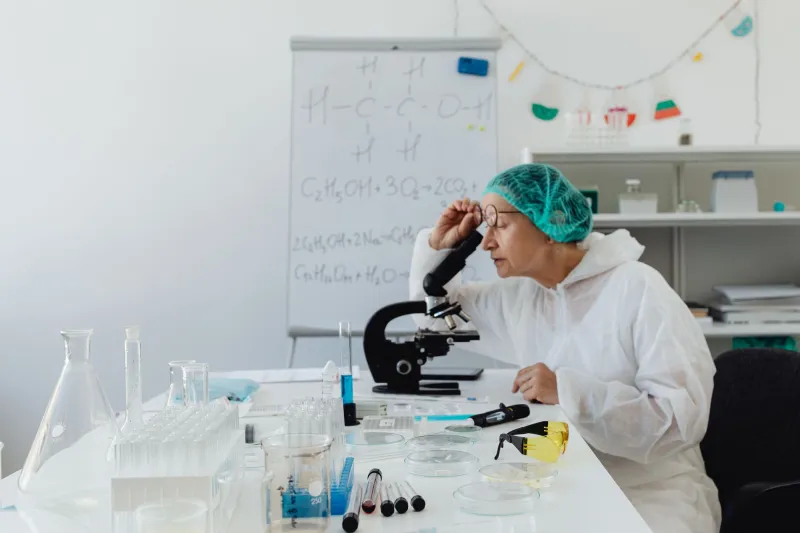
There's a version of the scientist story we all know. Prodigy kid. Full scholarship. Lab coat by twenty-two. Tenure by thirty-five. It's a clean arc, and it looks great in a university press release.
But that's not how it went for a lot of the people who have quietly changed what we know about medicine, biology, and human behavior. For them, the path ran through diner booths, retail floors, and overnight shifts at places that smelled like fryer oil and floor cleaner. And somewhere in all of that — in the chaos, the people-reading, the thousand tiny crises managed before breakfast — they built something that no textbook could have given them.
What "Being in the Weeds" Actually Teaches You
Any server will tell you what it means to be "in the weeds." Three tables just sat down at once. The kitchen is backed up. Someone's food is wrong. Someone else is about to walk. You have about forty-five seconds to triage the whole situation, make four people feel like they're your only priority, and somehow keep everything moving without anyone seeing you sweat.
That, it turns out, is an almost perfect simulation of what happens in a research lab when an experiment goes sideways, a grant deadline is two days out, and your lead postdoc just called in sick.
Dr. Sarah Brosnan, a primatologist and behavioral economist at Georgia State University, spent years working in food service before completing her doctorate. She's talked openly about how the experience of reading customer moods, managing group dynamics at a table, and negotiating between competing needs shaped the way she now studies fairness and cooperation in primates. The skills weren't metaphorical. They were literal. She knew how to observe behavior under pressure because she'd spent years doing exactly that — just with different primates.
The Long Road as a Feature, Not a Bug
American culture has a complicated relationship with the nonlinear career. We celebrate hustle, but we also quietly penalize anyone who didn't follow the expected sequence. The assumption is that if you took ten years to get your degree, or if you spent your twenties behind a bar instead of behind a microscope, you were somehow losing ground.
The scientists who came up through service work tell a different story.
Take the case of researchers who entered medicine after careers in hospitality management. Running a hotel kitchen means coordinating dozens of moving parts under strict time and safety constraints, managing personalities that don't always want to be managed, and making decisions with incomplete information. Those are the same cognitive muscles that get exercised when you're designing a clinical trial, managing a research team, or troubleshooting why your last three experiments produced inconsistent results.
Dr. Anthony Iton, who spent time in working-class jobs before becoming a physician and eventually a prominent public health researcher, has pointed to the experience of working alongside people navigating poverty and instability as foundational to his understanding of social determinants of health. He didn't just read about health inequity in a journal. He watched it happen in real time, to real people, in workplaces and neighborhoods that most research institutions never visit.
Reading the Room Is a Scientific Skill
Here's something that doesn't show up in the MCAT prep books: the ability to read a room — to sense what someone isn't saying, to notice the thing that's slightly off before it becomes a problem — is enormously valuable in research settings.
Lab environments are intensely human. Collaborations collapse. Egos flare. A brilliant grad student shuts down under the wrong kind of feedback. A promising line of inquiry gets quietly buried because nobody wanted to challenge the senior researcher who championed it. The scientists who spent years in service jobs — where emotional intelligence wasn't a soft skill but a survival tool — often navigate those dynamics with a fluency that their peers who went straight from undergrad to graduate school sometimes lack.
One physician-researcher who worked retail pharmacy for six years before medical school described the experience of counseling customers on medications they didn't fully understand as the real beginning of her patient communication education. She learned how to translate technical information into plain language, how to notice when someone was nodding but not actually comprehending, and how to build enough trust in a three-minute interaction that a person would actually follow through on what you told them. No residency seminar taught her that. The pharmacy counter did.
The Advantage Hidden in the Delay
There's a concept in organizational psychology sometimes called "prepared mind" learning — the idea that certain experiences only become useful once you have a framework to hang them on. Service industry veterans who go into science often describe something like this. The years spent managing chaos, reading people, and solving problems under pressure didn't make sense as training until they were actually in the lab. Then, suddenly, everything clicked.
The chaos of a slammed Saturday brunch service taught time management that no planner app can replicate. The experience of explaining a dish to a customer with dietary restrictions taught communication precision. The reality of working alongside people from every background imaginable taught a kind of cultural fluency that shapes how you design research, recruit study participants, and interpret data that involves human subjects.
None of this is to romanticize the grind of service work. It is hard, it is often undervalued, and the people who do it deserve far more respect than they typically receive. But the point is that the skills it builds are real — and they transfer.
Starting Late Isn't Starting Wrong
The scientists who came up through service jobs often talk about feeling behind for years. Behind the classmates who went straight through. Behind the colleagues who published earlier, got funding sooner, climbed the institutional ladder faster. The comparison is brutal, and the self-doubt it produces is real.
But there's another way to read the timeline. The person who spent a decade learning how humans actually behave — under stress, under constraint, in community with each other — before studying human behavior in a lab isn't behind. They're differently equipped. And in a field where the gap between theoretical knowledge and real-world application is one of the most persistent problems, that equipment matters.
The fringe path, it turns out, sometimes leads to the most grounded science.
The ones who waited tables and wore the lab coat didn't get a head start. They got something better — a reason to trust their instincts, a tolerance for ambiguity, and a firsthand understanding of the people their research was ultimately meant to serve.