The Seven-Year-Old Translator: From Family Interpreter to America's Top Diplomatic Trainer

Lost in Translation, Found in Responsibility
Elena Vasquez was seven years old when she realized that words could be weapons, shields, or bridges—depending on how carefully you chose them. Sitting in a sterile government office in Phoenix, she watched her mother's face crumple as an immigration clerk barked questions in rapid English, each syllable loaded with bureaucratic menace her parents couldn't decode.
"Mija," her father whispered, his calloused hand gently pushing her forward. "Tell them we have the papers."
But Elena knew it wasn't just about having papers. It was about the tone you used, the confidence you projected, the cultural cues that could mean the difference between cooperation and suspicion. At an age when most children were learning multiplication tables, she was mastering the delicate art of diplomatic interpretation.
This scene would repeat itself countless times over the next decade—in doctors' offices where medical terms became life-or-death puzzles, in school conferences where her parents' dreams for her education hung on her ability to translate not just words but entire worldviews, in landlord meetings where a misunderstood phrase could mean homelessness.
The Weight of Words
Every immigrant family has a child who becomes the bridge between worlds, but Elena's gift for language went far beyond simple translation. She developed an almost supernatural ability to read the subtext of conversations, to sense when a government official was genuinely trying to help versus when they were looking for reasons to deny a request.
"Elena didn't just translate words," remembered her fourth-grade teacher, Mrs. Patterson. "She translated entire emotional landscapes. I watched her turn hostile interactions into productive conversations just by adjusting her tone and word choice. It was remarkable to see in someone so young."
The burden was enormous. While her classmates worried about homework and playground politics, Elena carried the weight of her family's American dream on her shoulders. A mistranslation at the welfare office could mean no food for a week. A misunderstood medical instruction could have serious health consequences. The margin for error was zero.
But the pressure forged something extraordinary: a deep, intuitive understanding of how language shapes power, how communication can either build walls or tear them down, and how the smallest cultural nuances can determine the success or failure of entire relationships.
From Necessity to Mastery
By high school, Elena was interpreting for dozens of families in her Phoenix neighborhood. Word spread through the immigrant community about the teenager who could make American institutions listen, who could navigate the maze of bureaucracy with remarkable skill. She charged nothing—this was community service born from shared struggle.
She began to notice patterns. Certain phrases triggered defensive responses from officials. Specific approaches worked better with different types of bureaucrats. The timing of requests mattered almost as much as their content. She was developing, through pure necessity, the kind of cross-cultural communication skills that diplomats spent years learning in graduate school.
When Elena applied to Arizona State University, she wrote her admissions essay about the "accidental education" she'd received in government offices and medical clinics. The admissions officer who read it later said it was the most sophisticated analysis of intercultural communication he'd ever seen from a high school student.
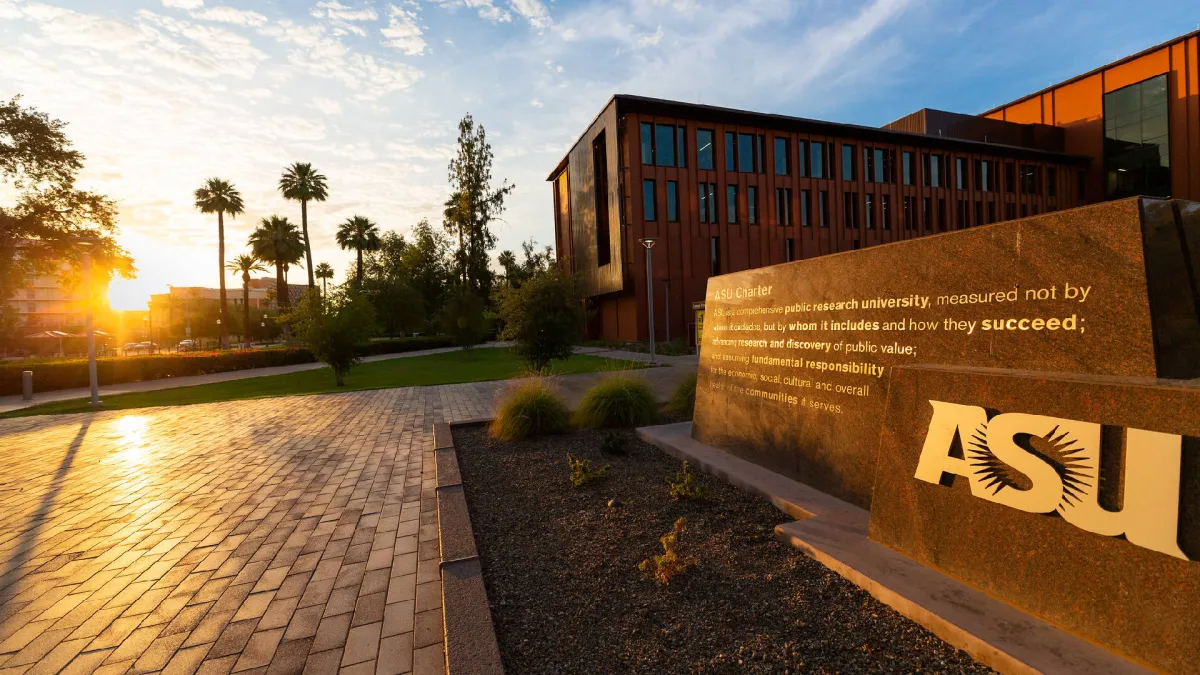 Photo: Arizona State University, via wallpapers.com
The Academic Awakening
At ASU, Elena majored in international relations and linguistics, finally putting academic framework around skills she'd been developing since childhood. Her professors quickly recognized that she brought real-world experience to theoretical concepts that most students only understood in abstract terms.
"Elena would sit in my diplomatic negotiation seminars and point out subtleties that I, with twenty years of academic study, had never considered," recalled Dr. James Morrison, who taught international communications. "She understood instinctively that successful diplomacy isn't about what you say—it's about how you make the other person feel heard."
For her senior thesis, Elena analyzed communication breakdowns in U.S. immigration policy implementation. Her research revealed that many policy failures weren't due to bad laws but to cultural miscommunication between federal agencies and immigrant communities. The thesis caught the attention of the State Department, which offered her an internship in their diplomatic training division.
Climbing the Foreign Service Ladder
Elena's State Department career was meteoric. Her ability to navigate complex cross-cultural situations made her invaluable in some of America's most challenging diplomatic posts. She served in embassies across Latin America, the Middle East, and Southeast Asia, consistently earning praise for her ability to build relationships in situations where other diplomats struggled.
But it was her work training new Foreign Service officers that truly set her apart. Elena recognized that traditional diplomatic education focused heavily on policy and protocol while largely ignoring the human dynamics that actually determined success or failure in international relations.
"We were teaching people to be policy experts," Elena later explained. "But we weren't teaching them to be cultural translators. We were sending brilliant people overseas who could quote treaties but couldn't read a room."
Revolutionizing Diplomatic Education
In 2018, Elena was appointed Director of Cross-Cultural Communication Training for the Foreign Service Institute, the State Department's premier diplomatic training facility. Her mandate was simple: fix the way America prepares its diplomats for the real world.
 Photo: Foreign Service Institute, via 2021-2025.state.gov
Her reforms were revolutionary. Instead of focusing primarily on language acquisition and policy briefings, Elena's new curriculum emphasized emotional intelligence, cultural pattern recognition, and adaptive communication strategies. She introduced role-playing exercises based on real-world scenarios, taught diplomats to recognize their own cultural biases, and developed assessment tools that measured cross-cultural competency alongside traditional diplomatic skills.
Most controversially, Elena instituted a requirement that all new Foreign Service officers spend time in American immigrant communities, serving as interpreters and cultural liaisons. "If you can't build bridges in your own country," she argued, "you have no business representing America overseas."
The Elena Vasquez Method
The results of Elena's reforms exceeded all expectations. American diplomats trained under her system showed dramatically improved performance ratings in their overseas posts. Embassy staff reported better relationships with local communities, more successful negotiations, and fewer cultural misunderstandings that escalated into diplomatic incidents.
Foreign governments began requesting American diplomats specifically trained in Elena's methods. The "Vasquez approach" became a model studied by diplomatic academies around the world. Countries as diverse as Canada, Australia, and Japan sent representatives to study her techniques.
"Elena taught us that diplomacy isn't about imposing your perspective," said Ambassador Sarah Chen, who went through Elena's training before her posting to Vietnam. "It's about creating space for multiple perspectives to coexist and find common ground. That's a lesson she learned as a child, and it's revolutionized how we represent America abroad."
Full Circle
Today, Elena Vasquez is recognized as one of America's foremost experts on diplomatic communication. She's written three books, delivered TED talks, and consulted for multinational corporations on cross-cultural negotiation strategies. But she hasn't forgotten her origins.
Every year, Elena returns to Phoenix to speak at the elementary school she attended as a child. She tells students—many of whom serve as translators for their own families—that the burden they carry is also a gift. That the skills they're developing out of necessity are among the most valuable capabilities in an increasingly connected world.
"I learned diplomacy in government waiting rooms," Elena tells them. "I learned negotiation in doctors' offices. I learned cultural sensitivity because my family's survival depended on it. You're not just helping your families—you're preparing for leadership in ways that no classroom ever could."
The seven-year-old girl who once trembled while translating for her parents had grown up to teach America's diplomats that the most powerful communication skill isn't speaking louder—it's listening deeper, understanding broader, and building bridges that connect not just languages, but hearts.